Archive | Uncategorized RSS feed for this section

What’s in a Bullpen Name?

8 Apr

Image

What’s in a name? If you’re a relief pitcher, it’s everything.

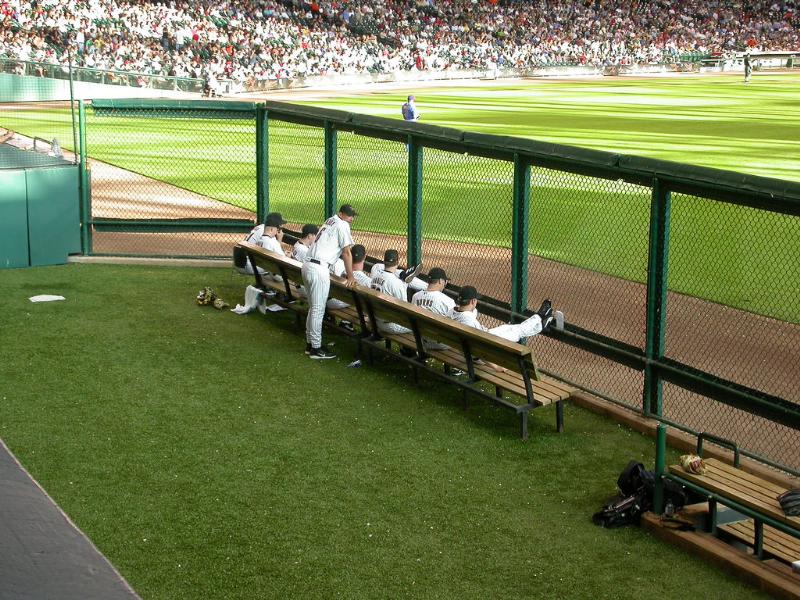
Because relief pitchers face far less hitters and appear more sporadically than starting pitchers, they’re just a name on the roster until they take their late game trot to the mound, emerging from a place who’s name itself is intimidating, the bullpen. It makes us conjure up images of the words historical meaning. Certain prison camps in the American Civil War and WWII were referred to as the bullpen. Or, we think of it’s literal meaning. A place where giant, ornary beasts are waiting to be brought to the chopping block, but suddenly one of them breaks through the fence wild and freed. The straight line sprint of John Rocker or the caffeine infused feet of Todd Coffey.

While charging like a bull from the pen can do a lot to intimidate a hitter, hearing a sterling name blaring through the PA can buckle a hitter’s knees in the on-deck circle.

Yes, beer guts, mustaches and not speaking any English contribute to a reliever’s reputation, but a name can eloquently paint the picture of a man you do NOT want to see on the mound.

It can be something as simple as alliteration, like the Tiger’s Al Alburquerque or former Minnesota big man Boof Bonser. Their names stick in your brain like nursery rhymes.

Animalistic nicknames stick to relievers, no matter what particular species. Does anyone really know Goose Gossage‘s real name. It’s Richard, but after playing for nine different teams in his hall of fame career, it made it easier on everyone to just call him Goose.

Some guys are blessed by birth with naturally tough sounding names. Tug McGraw and Paul Assenmacher. Yes, there’s jokes to be made with both of those names, but each of them spent over 13 years in Major League bullpens.


All you need sometimes is just two syllables. First, last. Rod Beck. Lee Smith. Short, sweet.

Other relievers are benefit from exotic mystique. When a name sounds so foreign your tongue tingles pronouncing it correctly, you know you don’t want to see them warming up for the ninth. PA announcers across the league relished introducing Shingo Takatsu or Mariano Rivera.

And then, there’s guys you can tell that they’re not only Major Leaguers, but crafty late inning hurlers. Rollie Fingers. Bobby Thigpen. Enough said.

Bullpen heroes are something to be treasured by baseball fans everywhere. The pitcher may get yanked, but the names will live on beyond the fences.
Image

The Catholic 7’s Next Move?

13 Jan

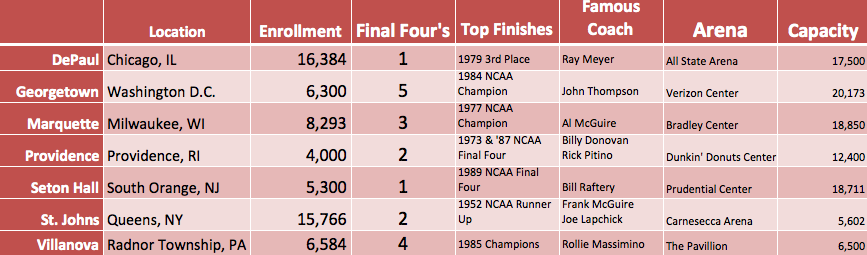
When DePaul, Georgetown, Marquette, Providence, Seton Hall, St. Johns and Villanova decided to leave the Big East a month ago, it was (and still is) uncertain what the schools will do regarding their conference fate.

Since the announcement, ESPN’s Darren Rovell has reported that the “Catholic 7” will look to add three-to-five schools in order to form a 10- to 12-team conference. This will make them a balanced conference, and attract a power conference-type TV deal. The question, however, is who should get the invite?

The seven former Big East schools share a lot in common. (Click to enlarge)

Image

They’re all mid-sized Catholic Universities located in or near major urban areas with storied basketball traditions and no Division I FBS football program. There are several schools in the A-10 and Horizon League that fit that description.

Image

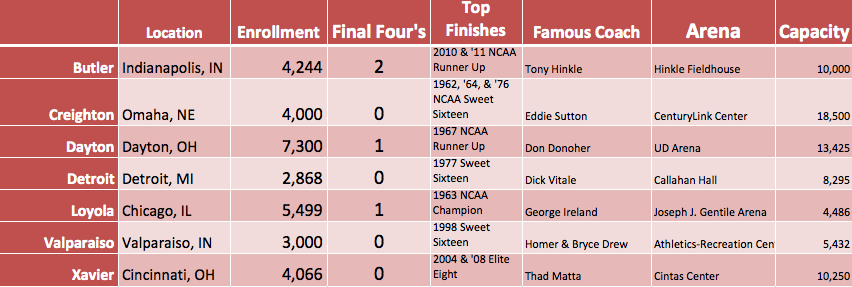
Dayton and Xavier would be natural fits to join the Catholic 7. The two schools have a combined nine Tournament appearances in the past ten years, with Xavier reaching the Elite Eight in ’04 and ’08.

Butler might be the toughest catch, but it would be worthwhile. They would be the only non-Catholic school (they’re affiliated with the Christian Church). That aside, Brad Stevens is looking like the next great college coach, and they would add two more Final Four appearances to the Catholic 7’s existing 18.

Loyola is a program that seems to be on the rise, along with their North Side of Chicago neighbor DePaul. Renew that rivalry in an already basketball crazy town.

Valparaiso and Detroit also have a history with many of their Midwestern Catholic brethren. At roughly 3,000 full-time undergraduates, both schools have lower attendances than any of the school’s mentioned. Both schools are at the top of the Horizon League. Detroit has a bona fide star this season in Ray McCallum Jr. and who can forget current Valpo head coach Bryce Drew‘s 1998 buzzer beater (and subsequent swan dive.) His father Homer was his coach that season, just as Ray Jr. currently plays for Ray Sr. at Detroit.

Another school that would fit the bill could be MVC giant Creighton. The Blue Jays have a formidable father-son duo themselves in head coach Greg and high-scoring guard Doug. They’ve gone dancing eight out of the past fourteen seasons.

With the conference realignment epidemic crossing over to the basketball side of things, Depaul, Georgetown,, Marquette, Providence Seton, Hall, St. John’s and Villanova have a chance to form a basketball that is as strong top-to-bottom as any conference in the NCAA.

In the coming months, we will see.

Aside

Loyola Outlasts Fenwick

10 Oct

There was nothing ordinary about Loyola’s 49-28 win over Fenwick Saturday in Wilmette.  In a game that saw each team throw an interception on their very first play from scrimmage, the Ramblers (6-1, 2-0) wore out the Friars (5-2, 2-0) in the crossover matchup of Catholic League division leaders.

“We just came out flat.” Loyola QB Peter Pujals said.   “Flat” could be an understatement. Pujals completed four of his fist eight passes; two to Loyola receivers, two to Fenwick defensive backs. Two big gains were taken away from the Ramblers as well, as they committed four penalties amassing fifty yards.  After two quarters of play, the Friars stood even with the 2nd ranked Ramblers, 14-14.

“We wanted to come out in the second half, and treat it as a new game”, said Pujals, who finished the day 15-31 for 264 yards. That the Ramblers did when Kristopher Coker returned the opening kickoff for a 95-yard score.  The Friars, however, fought back with a big play of their own.  After recovering a Pujals fumble in Loyola territory, Fenwick QB Gino Cavalieri scrambled away from the Loyola pass rush, and threw a prayer of a pass to WR Danny Lattner, who readjusted to the ball to make a spectacular catch in the end zone.

It wasn’t until their first drive of the fourth quarter that Loyola was finally able to pull away from the Friars. In response to an 80-yard touchdown pass from Cavalieri to WR Patrick Regan to begin the fourth, Pujals led the Ramblers on an 80 yard scoring drive.  On 4th and 3 with 9:43 on the clock in a tie ballgame, Pujals scrambled for a first down and put the Ramblers at Fenwick’s doorstep.  The very next play Pujals connected with senior two-way starter Luke Ford on a 14-yd fade route to the corner of the end zone, to put Loyola ahead for good.

The Friars were ready for the Ramblers.  They quickly took a 7-0 lead on a blocked field goal returned 90 yards by defensive back Keshaun Smith.  The Fenwick defense stifled the Catholic League’s top offense early, and continued to play strong late into the fourth quarter.  “Our defense is always ready to step up. When we’re called, we’re always ready”, said Smith.

The Loyola defense handled the Fenwick ground game, dominating the line of scrimmage the entire game, allowing only two runs of over ten yards.  One of those runs was a 32-yd dash by Robert Spillane, who turned the corner on the Loyola defense and ran up the sideline virtually untouched, tying the score at 14 just before halftime.

Loyola may have been looking ahead to its final two games against fellow CCL Blue members Brother Rice and St. Rita, or even the top-level teams that await them in the 8A playoff bracket. Pujals says the Ramblers will attempt to maintain their focus, and finish the season strong, “We learned we need to take it one game at a time, and focus on Brother Rice next week and we’ll go from there.”

The Friars look to close out their 2012 regular season with a CCL White division title, and look forward to an always tough 7A pool.  The Friars are one win away from a guaranteed playoff berth, and the only obstacle that stands in their way of a division title is a Week 9 Showdown with De La Salle on 35th Street.

Dominating the Digital Domain

26 Sep

The capability to tell a vivid story has been vastly increased by the Internet. Writer’s are not limited to 400 or 600 words, producers are not limited to simple video clips. The ease of generating multimedia content combined with the sheer magnitude of information and images  the internet offers make it easier than ever to grab audience attention.

However, as Homer Simpson so eloquently put it, “(It’s the fourth quarter) The Lord gave us the atoms. It’s up to us to make ’em dance.” The stories are there to be reported, it’s up to individual journalists to make them sizzle.

We have the resources available now to tell stories that are more vivid, more bold, more lifelike.  From databases, to calculation tools, to photo libraries, journalists are using every tool available to them to round out their work and deliver a total package to the audience.

Two journalist’s I follow very closely across several media is Chuck Garfien and Chris Rongey.  Each hosts the White Sox pre-game and postgame shows on TV and radio respectively.  In addition to their daily lead in and wrap up duties, the two are very keen to social media.

Garfien & Rongey are especially adept Twitter, as each has a strong following.  During our home game batting practice, for instance, Garfien might tweet about the mammoth shots Tyler Flowers was hitting or how John Danks said his arm felt last night. This is information that a hungry audience might like to know, but not read 200 words about.

Rongey is more active than most when it comes to tweeting back to fan questions and comments.  On game days, he is active online for hours before the first pitch, while he’s watching from the press box, and well after everyone’s left the ballpark.  When his own knowledge may fail him, database tools such as baseball-reference.com come in handy. Hidden trends and startling statistics can be drawn using the site and its countless number of filters.

Similar to baseball-reference.com, yet much more lucid is fangraphs.com, which allows users to take stats and splits, and visualize them using a different number of graphs and charts.  Fangraphs.com also uses video replay, still frames, and .gif’s to bring to life its content; Jeff Sullivan uses all three to point out that only one triple has been hit by right handed batters at Progressive Field this year.

Twitter is one of the best ways to reach audiences with content, or, to be your sole source of content. Andy Gray uses his twitter solely to post old Sports Illustrated photos on a daily basis. His pictures are fascinating and topical, ranging from celebrating Mr. T’s birthday with entire gallery spanning four decades, or photos of the best tailgates around the country on an October Saturday.

The opportunities are endless, and the resources are plenty. It’s up to the journalist’s to master their digital domain.

Online Content Creates More Vibrant Legacy

12 Sep

I recently watched a PBS Frontline documentary on high school football that outlined the immense pressure some programs are under to win, and the rising health risks that are becoming more and more prevalent in the sport at this level.  The program instantly grabbed my attention, as it told the story of several players who were directly affected by heat stroke or concussions that could/should have been prevented.

As the program went on, my curiosity was sparked more and more. They touched on topics such as state regulations on high school sports safety and the heavy recruitment of stud athletes, and I wanted to know more, I had questions about the documentary that I wanted answered. Sure, I could go on Google for a few hours and try and look up the information I was looking for . . or I could simply scroll down the page and find the answers to nearly all of my questions provided by PBS. This new style of complete coverage in media supplies its audience with content one wouldn’t normally get from traditional, or “legacy” media coverage(meaning the New York Times newspaper or an ABC News broadcast on television).

The PBS Frontline website provides a wealth of information not contained in the documentary. Whether I wanted to know the specifics of concussion studies mentioned in the documentary, or the fate of some of the star players that the program followed, it’s all there at my fingertips.  Whereas legacy media coverage ends when the last line in print or an anchor’s sign off, this new style of coverage goes deeper, and offers its audience much more than ever before.

Another program I viewed on the PBS website concerning the NCAA Basketball Tournament was equally as riveting, and equally as question-raising.  This documentary was concerned with the millions of dollars the non-for-profit NCAA makes on its annual Tournament. The most gripping interview was that of Mark Emmert, NCAA President.  Though only a few clips of it aired on the program, the transcript of the entire interview can be found on the Frontline website, along with every other interview that aired in the program.  Years ago, this type of content was never available to the audience. Online coverage allows a story to be told more in-depth and with greater detail than ever before.