The Tuesday before the season of Lent goes by many names. Some people call it Fat Tuesday. In New Orleans, it’s Mardi Gras. But to me, and anyone who grew up within walking distance of a good Polish bakery, it’s Paczki Tuesday.
I have to have my paczki on Paczki Tuesday.
A paczki (POONCH-key) is dough, and fruit filling, covered in powdered sugar. Essentially, it’s a paczki is a jelly donut, right?
Brother, you’ve never been more wrong in your life.
You could go to Dunkin Donuts or Krispy Kreme and pick up a bakers’ dozen of raspberry jelly, pass them off as paczki and few people would know the difference. Heck, even supermarket chains from Kroger’s to Hannaford’s put their bakers to work every February to try and recreate the magic, and for the most part, they do a good job.
But to get a good paczki, you’ve got to find a Polish bakery.
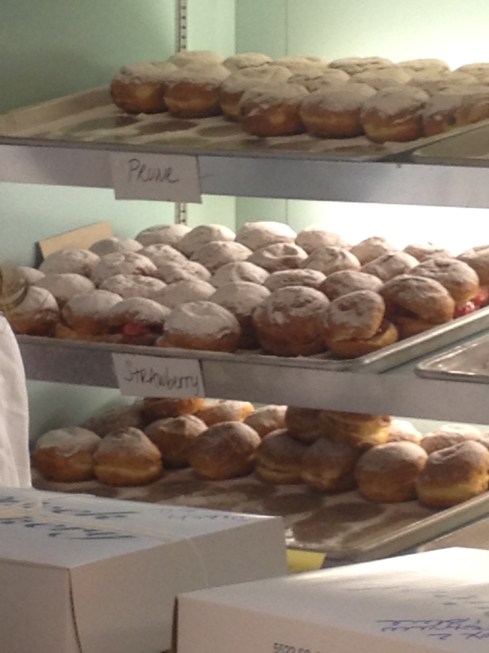
When made right, paczki are more rich, more flavorful, more fattening than their donut counterparts. A good paczki has two dough “halves” and in the middle is the sweet fruit or cream filling. Not jelly, handmade filling. Strawberry. Raspberry. Apple. Peach. Whipped cream. Bavarian. Mmmmmmm.
2016 was my first year living in Alabama, and I called around all over Huntsville to find a local bakery that was making paczki, but couldn’t find any. When I told my girlfriend Chelsea about my problem, she being the wonderful woman that she is, started calling every bakery within a 200 mile radius. And sure enough, she found a little shop called Koch’s Bakery in downtown Chattanooga who was taking orders before the big day. 21 varieties. Handmade. The pictures had me drooling.
We both took a day off to drive for two hours up to Chattanooga for our Polish treats, and Chelsea, bless her heart, had to put up with four hours in a car with me listening to nothing but polka.
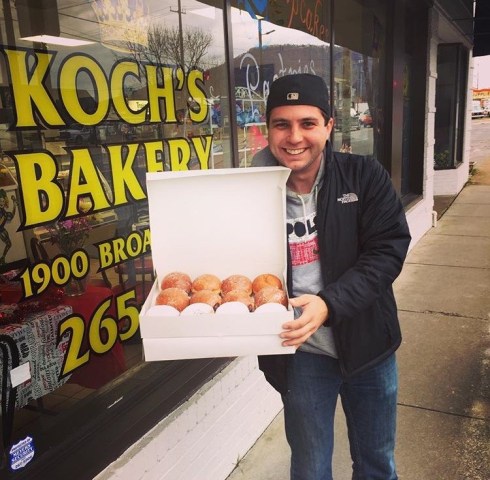
As I sit here this year, with simple grocery-store paczki from Kroger, I realize that when it all boils down to it, a paczki is a paczki.
And paczki are as much about the Polish identity as they are the rich doughy goodness.
I’m Polish. My dad’s Polish. My mom’s Polish. They first met on a Paczki Tuesday 35 years ago. And their parents were Polish. And their parents were Polish. And their parents were Polish.
It’s in those generations of Poles, and that long storied Polish history that I have found the true meaning of Paczki Tuesday.
It’s about connecting with the Polish identity.
The real story of Paczki Day goes back centuries. It’s a Catholic tradition to fast and make a personal sacrifice (i.e. giving up sweets) for the 40-day Lenten season before Easter. But before Ash Wednesday, to prepare for seven weeks of deprivation, all the old Polish women would use up all their fat and lard and sugar. Thus, the paczki was born.
That explains the pastry, but the patriotism is a much longer story.
For the better part of the past 300 years, Poland was a nation without a claim. It disappeared from the political landscape. Partition after partition from empires both east and west left the land that makes up modern-day Poland looking Venn diagram. The Russians. The Austrians. The Prussians. The French. The Germans. The Soviets. (Why was everybody fighting over Poland? Was it the paczki? I’m sure if Napoleon or Stalin would have asked, a nice old woman from Warsaw would have gladly shared her recipe for the perfect paczki.)
Poles had no flag, no nation, and no say.
There was no body. Just a soul.
But that soul was made up of food, music, poetry and paintings. That soul had an attitude, a work ethic. That soul had it’s own language which some of the most brilliant minds of the new millennium spoke so eloquently, and values that some of the most courageous and accomplished men in all of history fought to uphold.
In the 1940’s, a young man from just south of Krakow embodied all of these Polish ideals. His name was Karol Wojtyla.
When the Nazi’s invaded Poland in September of 1939, they installed their government, forced labor and attempted to erase all signs of the Polish culture. Men were sent against their will to work in factories to fuel the Nazi war machine. Plays were forbidden. Practicing religion could get you shot on sight.
Freedom and liberty were non-existent in Nazi-occupied Poland. At least, not on the surface.
A brilliant young student, actor and writer, Karol kept his culture, and the culture of an entire nation alive in the basements and barns of Poland. He wrote and acted in plays with a small group of classmates, sometimes performing in a basement for a dozen people, as not to attract attention and be discovered. He risked his life to help the local priest run a clandestine ministry, often darting through the streets after curfew eluding Nazi watchmen. He poured his heart out to help others, whether it be with a slice of bread to feed a friend or a thoughtful poem that captured the essence of the Polish plight. The Nazis killed the body of Poland, but there’s no way they could kill the soul.
That spirit of courage, dignity, creativity, selflessness and defiance is what I think of every time I bite into a paczki. That’s the true meaning of Paczki Tuesday.
Note: Poland was eventually liberated in 1945. Karol Wojtyla eventually became Pope John Paul II.
 Jake Berent
Leave a comment